 Michael Prewett
Cancer is often described as a genetic disease, and most standard-of-care treatments are based on this premise, but increasing evidence suggests it’s a metabolic one of mitochondria dysfunction which operates ahead of any genetic changes.
Tumor cells thrive on glucose, while most cannot efficiently use ketones as fuel. This imbalance has led researchers such as Professor Thomas Seyfried of Boston College, USA to describe cancer as a “metabolic disease”—a conflict played out at the level of cellular fuel. Seyfried’s work also shows that the two main metabolic drivers are glucose and glutamine—an abundant amino acid essential for both healthy and cancerous cells (Seyfried, et al. 2013).
For patients, the challenge is clear: how can we track this war inside our own bodies? That’s where glucose and ketone monitoring come in. By regularly testing and calculating the Glucose-Ketone Index (GKI), it becomes possible to see whether the metabolic terrain is shifting—toward cancer’s advantage or toward recovery.
Why Tracking Matters
Without measurement, it’s like fighting blind. Glucose and ketone meters provide feedback in real time. They also reveal something textbooks can’t: individual differences.
Two people can eat the same meal, yet one may experience a sharp glucose spike while the other sees little change. These responses are highly individual, shaped by genetics, gut microbiome, and prior metabolic health. For anyone beginning a fasting or ketogenic approach, testing is essential—not just to confirm ketosis, but to understand how specific foods influence metabolic balance.
In my own experience, tracking was what transformed theory into practice. Numbers gave me a map. They showed when a strategy was working, and when adjustments were needed. Once you establish a trend and know how you react to certain foods, you don’t need to test daily—but occasional GKI checks keep your compass calibrated.
For example, if I eat guacamole (which is part of my mimicking-fasting plan) on a slice of bread, glucose values go up. But if I repeat this on a Ryvita biscuit, there is hardly any difference. That simple comparison highlights why self-tracking matters.
Fasting, OMAD, and the Press–Pulse Concept
Among the many metabolic strategies under study, fasting and One Meal A Day (OMAD) patterns stand out. Both are supported by peer-reviewed evidence suggesting benefits for metabolic health, immune function, and possibly cancer outcomes (Pavlova et al. 2016).
Professor Seyfried’s concept of press-pulse therapy provided a useful framework. The “press” refers to constant metabolic pressure (for example, maintaining a low-glucose environment), while the “pulse” involves periodic intensifications—such as periods of rigorous exercise.
Seyfried’s research also emphasizes that while glucose restriction can limit one key energy source for tumor cells, glutamine—an abundant amino acid used in cell growth and repair—can serve as a secondary fuel. My own approach therefore aims to address both drivers metabolically, but in a balanced way that maintains normal cell health. This is where fasting, nutrient timing, and gentle metabolic stress come together.
Inspired by this model, I developed my own modified approach, (because I didn’t have any access to experimental drugs to limit glutamine – and I am purely holistic anyway) combining fasting cycles with nutritional strategies. While the exact details are my own, the principle is simple: Apply controlled metabolic stress, then track its effect.
Tracking these interventions with the Glucose-Ketone Index (GKI) allows you to see whether the combined press-pulse effect is truly shifting metabolism.
The Glucose–Ketone Index (GKI)
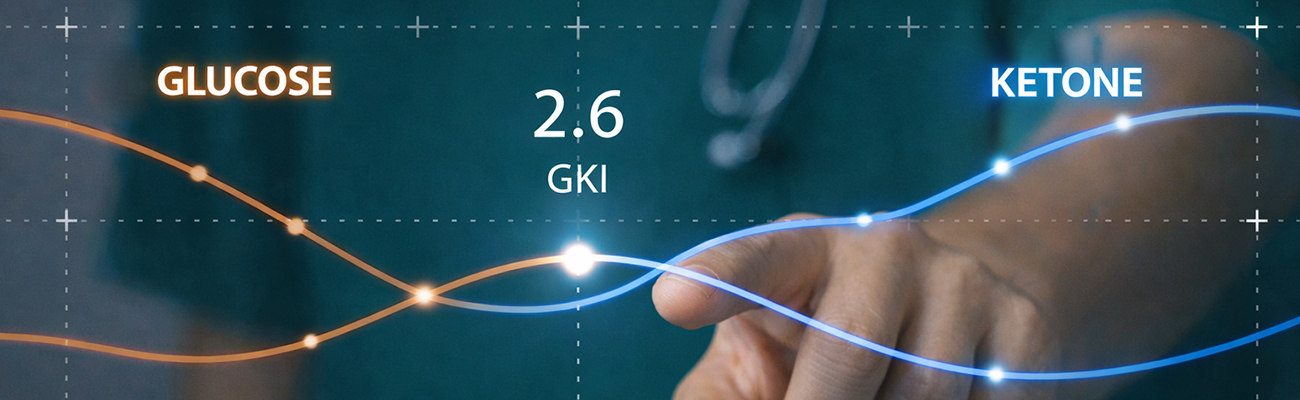
The GKI is one of the most practical ways to monitor the balance between glucose and ketones. It is calculated by dividing glucose (in mmol/L) by ketones (also mmol/L). In the US you may use different units, but you will need to convert to mmol/L.
- High GKI (>9): little metabolic stress on tumor cells.
- Moderate GKI (3–9): transitional zone.
- Low GKI (<3): strong ketosis, potential therapeutic benefit.
- Seyfried suggests a therapeutic target of GKI < 2.
What makes the GKI valuable is that it integrates both glucose and ketone data, offering a snapshot of the metabolic “battlefield.” While a single reading provides information, tracking over days or weeks reveals patterns—how fasting shifts metabolism, how quickly ketones rise, and how sustainable these states are. Certainly, track over the days you are fasting or mimicking fasting.
Beyond the Numbers: Biomarkers and Imaging
Of course, no single measurement tells the whole story. Blood glucose and ketones are vital indicators, but cancer recovery must also be assessed through broader biomarkers:
- Inflammatory markers such as C-reactive protein (C-RP)
- Tumor markers like CEA, CA19-9 or CA-125, depending on the cancer type.
- Imaging scans (MRI, CT) to objectively track changes in tumor size.
Recent peer-reviewed studies in Carcinogenesis and Cell Metabolism have echoed Seyfried’s findings, showing how restricting both glucose and glutamine availability can stress tumor metabolism.
These objective measures help answer a difficult but necessary question: if multiple strategies are applied—fasting, diet, exercise, supplements—which one did the heavy lifting? The reality is we may never know with certainty. What matters is whether the combined approach shifts outcomes in the right direction.
Lessons Learned
From my own journey, a few lessons stand out:
- Track early and often. A meter is not optional; it is the compass that keeps the strategy on course.
- Expect variability. Responses change over time. What worked one month may need adjustment the next.
- Use multiple measures. Pair GKI tracking with biomarkers and imaging for the clearest picture.
- Stay objective. Improvements may come from multiple factors—humility is part of the process.
- Prioritize quality of life. Strategies must be sustainable; recovery is a marathon, not a sprint.
Closing Reflection
Cancer is complex, and no single approach offers guarantees. But framing it as a metabolic war opens new ways of thinking. By tracking glucose and ketones, we gain insight into the hidden battlefield inside the body.
My experience has been that measurement is empowering. It transforms uncertainty into action and theory into data. While research continues to evolve, one lesson is clear: with the right tools and a willingness to track, patients can become active participants in their own recovery journey.
REFERENCES
Pavlova NN & Thompson CB. The emerging hallmarks of cancer metabolism. Cell Metab. 2016 Jan 12;23(1):27–47.
Seyfried TN, et al. Cancer as a metabolic disease: implications for novel therapeutics. Carcinogenesis. 2013 Dec 16;35(3):515–527. (PMC version: PMC3941741)
This blog post reflects the opinion and/or experience of the author. It is provided for informational purposes only and should not be considered a replacement for professional medical advice, diagnosis, or treatment. If you have any questions about a health condition or concerns related to your well-being, always consult with your physician or another qualified healthcare professional.